Skip to content
Nuvologic Electronics, home Discuss your requirement

Project evidence

Embedded design projects

Systems built and shipped by the Nuvologic team for OEMs in India, the USA, Mexico and Singapore, with the hardware, firmware, connectivity and software behind each one, and what they achieved in the field. Customer names stay confidential, and where a result or test report is not published, the case file says so.

CASE 01Industrial weighing · Hardware, firmware and software

In Motion Weighing

Customer challenge
Capture vehicle weight in motion, at line speed, with repeatable industrial accuracy.
Engineering scope
Hardware, firmware and application software for one weighing controller.
System architecture
Four PCBs in one product. A six-layer LPC1788 main board connects field I/O to an ASP.NET application, Azure storage and an Android app.
Technologies used
LPC1788 Cortex-M3, external RAM, flash and EEPROM, RTOS, emWin, Modbus RTU and TCP, Ethernet, USB, RS485, RS232, Azure and Android.
Design and validation
Field-deployed. A separate validation report is not published for this project.
Actual results
Installed in weighbridges and in-line checkweighers, handling around 1,000 vehicle readings a day, with event-wise cloud readout.

A complete hardware, firmware and software stack for an industrial embedded system. The hardware has four PCBs within a single product, including a six-layer main board built around an LPC1788 Cortex-M3 controller, with external RAM and flash, EEPROM, a 24-bit LCD, Ethernet, USB, RS485, RS232, multiple analog inputs and outputs, isolated encoder interfaces and brownout protection.

The firmware uses a bootloader, an RTOS and the emWin GUI, with TCP/IP, Modbus RTU and TCP, device control, logging, PID control and printer output. The software side covers application development with Visual Studio and ASP.NET, cloud data storage on Microsoft Azure, graphical dashboards, and an Android app with Modbus TCP support.
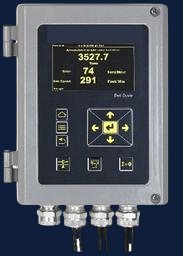
The in-motion weighing controller: a steel enclosure with a display showing a weight reading and a membrane keypad

Outcome · field-deployed

Installed in weighbridges and in-line checkweighers across industrial logistics hubs, handling around 1,000 vehicle readings a day with event-wise cloud readout.

Controller
LPC1788 (ARM Cortex-M3)
Boards
Four PCBs; six-layer main board
Interfaces
Ethernet, USB, RS485, RS232, analog I/O, isolated encoders
Firmware
Bootloader, RTOS, emWin GUI, Modbus RTU/TCP, PID
Software
ASP.NET, Azure storage, dashboards, Android app

Field I/O

  • Analog inputs and outputs
  • Isolated encoders
  • Printer output

Six-layer main board

  • LPC1788 · Cortex-M3Bootloader · RTOS · emWin · PID
  • RAM, flash and EEPROM
  • 24-bit LCD

Links

  • Ethernet · Modbus TCP
  • RS485 · Modbus RTU
  • USB · RS232

Software

  • ASP.NET application
  • Azure storage and dashboards
  • Android app
System outline, drawn from the project description.

CASE 02Weighing instrument · Hardware and firmware

Scales Weight Indicator

Customer challenge
A weighbridge indicator that stays accurate and auditable when the cloud connection is intermittent.
Engineering scope
Embedded hardware and firmware for the indicator, including field calibration support.
System architecture
Load-cell ADCs feed a Cortex-M4 or M7 controller, with a capacitive-touch keypad and Wi-Fi and Bluetooth beside the instrument.
Technologies used
ARM Cortex-M4 and M7, precision load-cell ADCs, capacitive-touch keypad, Wi-Fi, Bluetooth, RTOS and an in-house embedded framework.
Design and validation
Field-calibrated. The calibration record is not published on this page.
Actual results
Tally records stay in internal memory. Local logging and offline calibration keep weighbridge readings auditable when the cloud connection drops.

A compact embedded hardware and firmware design built for accurate, smooth operation. The hardware is based on ARM Cortex-M4 and M7 microcontrollers with built-in Wi-Fi and Bluetooth, precision load-cell ADCs for accurate measurement, and capacitive touch keypads. Operational data such as tally rolls is stored in internal memory.

The firmware runs on a real-time operating system and an in-house embedded framework, giving stable performance, easy maintenance and clear menu navigation.

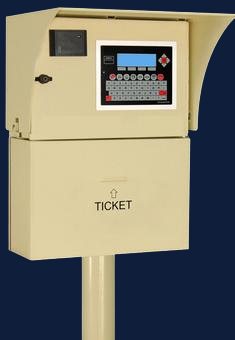
The scales weight indicator: a pole-mounted terminal with a hooded display, keypad and ticket printer

Outcome · field-calibrated

Tally records stay in internal memory across power cycles. Local logging and offline calibration keep weighbridge readings auditable even when the cloud connection is intermittent.

Controllers
ARM Cortex-M4 and M7
Measurement
Precision load-cell ADCs
Connectivity
Wi-Fi and Bluetooth
Interface
Capacitive touch keypad
Firmware
RTOS, in-house embedded framework

Measurement

  • Precision load-cell ADCs

Controller

  • ARM Cortex-M4 / M7RTOS · in-house framework
  • Internal data storage

Operator

  • Capacitive touch keypad
  • Menu navigation

Wireless

  • Wi-Fi
  • Bluetooth
System outline, drawn from the project description.

CASE 03Connected devices · Hardware, firmware, apps and cloud

Home Automation

Customer challenge
A connected-home controller that stays usable when the homeowner’s internet drops, and that can take OTA updates without field failures.
Engineering scope
Device firmware, Android and iOS apps, and the cloud side of a connected product.
System architecture
Local Wi-Fi and Bluetooth control on the device, with MQTT or HTTP over TLS to Azure, and Android, iOS and web apps.
Technologies used
MQTT, HTTP/HTTPS, Bluetooth Low Energy, Wi-Fi, TLS, OTA updates, RTOS, Azure, Android and iOS.
Design and validation
Offline command path, signed firmware updates, a per-unit self-test and staged OTA waves. The rollout log is not published here.
Actual results
About 10,000 units a year in the field. Local control survives connectivity drops, and OTA updates roll forward without field failures.

A wall-mounted control unit for connected homes, built to stay usable when the homeowner’s internet goes down and to take OTA updates without field failures.

A firmware and software foundation for connected IoT systems. The firmware supports MQTT, HTTP/HTTPS, Bluetooth Low Energy and Wi-Fi with TLS encryption, plus OTA firmware updates, time synchronization, email and file transfer services and RTOS-based communication handling.

The software includes in-house Android and iOS apps, web and back-end development, cloud integration with Azure, server and data management for IoT platforms, and analytics, with attention to data privacy and encryption.

  1. 01 · LocalOffline command path Local control stays available when the internet drops.
  2. 02 · SecureSigned firmware updates Only a signed update is applied.
  3. 03 · Self-testPer-unit self-test Each unit checks itself before it stays on the new firmware.
  4. 04 · RolloutStaged OTA waves Updates go out in stages. Batch size and halt rules are not published.

Outcome · about 10,000 units a year in the field

Local control survives connectivity drops, and OTA updates roll forward without field failures.

Protocols
MQTT, HTTP/HTTPS, BLE, Wi-Fi, TLS
Firmware
OTA updates, time sync, RTOS-based communication
Apps
Android and iOS
Cloud
Azure integration, data management, analytics

Device firmware

  • RTOS-based communicationOTA updates · time sync
  • Redundancy management

Links

  • Wi-Fi · BLE
  • MQTT · HTTP/HTTPS
  • TLS encryption

Cloud

  • Azure integration
  • Data management
  • Analytics

Apps

  • Android
  • iOS
  • Web
System outline, drawn from the project description.

CASE 04Power electronics · Hardware

Battery Charger

Customer challenge
Charge 12 V DC flooded and VRLA batteries on more than one channel, including recovery from deep discharge.
Engineering scope
Charger hardware with per-channel regulation, status indication and protection.
System architecture
Two or four channels, expandable in pairs. Each pair runs its own charge profile, with LED status from start-up to full charge.
Technologies used
Current and voltage regulation, deep-discharge recovery, and over-current, short-circuit and reverse-polarity protection.
Design and validation
Protection behaviour is part of the design. A published test report is not included here.
Actual results
Protects 12 V DC backup batteries during fault events, with predictable recovery from deep discharge in service.

A safe, flexible battery charging system with built-in protection and customization options. Safeguards include over-current, short-circuit and reverse-polarity protection. The charger supports flooded and VRLA batteries, allows selection for multiple 12 V DC batteries, and can charge deeply discharged batteries.

LED indicators show charging status from start-up to full charge. The design can be configured with two or four charging channels, and customized further in multiples of two channels; each pair runs an independent charge profile.

Outcome · automotive sector

Protects 12 V DC backup batteries during fault events, with predictable recovery from deep discharge in service.

Batteries
Flooded and VRLA, 12 V DC
Protection
Over-current, short-circuit, reverse polarity
Channels
Two or four; expandable in multiples of two
Status
LED charging indication

Charging

  • Charge controlFlooded · VRLA · deep discharge
  • Battery type selection

Protection

  • Over-current
  • Short-circuit
  • Reverse polarity

Channels

  • Two or four
  • Expandable in pairs

Status

  • LED charge indication
System outline, drawn from the project description.

CASE 05Healthcare · Hardware, firmware and validation

Medical Cart

Customer challenge
A clinician-grade mobile workstation with a touchscreen and a battery that lasts a clinical shift.
Engineering scope
Hardware (battery, enclosure and wireless connectivity), firmware (touch interface and communication) and validation, by one team.
System architecture
A battery-driven cart with 2 to 12 drawers. The current controller is an Arm Cortex-M4 with a touchscreen; Wi-Fi and Bluetooth carry updates from the hospital side.
Technologies used
Arm Cortex-M4, RTOS, touchscreen calibration, Wi-Fi and Bluetooth. An earlier generation used ESP-IDF-based firmware.
Design and validation
Validation was in the project scope. The validation file is not published here.
Actual results
Battery runtime is sized for a clinical shift in the configured model. No further measured result is published.

A battery-powered clinical cart that pairs with hospital software. The challenge: a clinician-grade mobile workstation with a touchscreen and a battery that lasts a clinical shift. One cross-functional team handled the hardware (battery, enclosure and wireless connectivity), the firmware (touch interface and communication) and validation.

The hardware is a battery-driven mobile enclosure with a configurable drawer count from 2 to 12, a sturdy, disinfectant-tolerant chassis, and Wi-Fi and Bluetooth for updates from the hospital’s EMR side. The current generation runs on an Arm Cortex-M4 with an RTOS scheduler, touchscreen and calibration; an earlier generation used ESP-IDF-based firmware.

Outcome

Cortex-M4 firmware, a touchscreen interface and Wi-Fi/Bluetooth communication, with battery runtime sized for a clinical shift in the configured model.

Controller
Arm Cortex-M4 (current generation)
Firmware
RTOS, touchscreen and calibration
Connectivity
Wi-Fi and Bluetooth
Mechanics
2 to 12 drawers; disinfectant-tolerant chassis
Power
Battery sized for a clinical shift

Cart

  • Battery-driven enclosure
  • 2 to 12 drawers

Controller

  • Arm Cortex-M4RTOS · touch calibration

Clinician

  • Touchscreen interface

Hospital systems

  • Wi-Fi · Bluetooth
  • EMR-side updates
System outline, drawn from the project description.

CASE 06Industrial inspection · Customized PLC and software

Inspection System Controller and Operator Software

Customer challenge
See live gauging results, a pass or fail verdict, and the trend of those measurements on one machine.
Engineering scope
Customized PLC hardware, control firmware and the .NET operator console, from the same team.
System architecture
Gauges feed the PLC. The PLC runs the machine sequence. The operator console shows parameters, mastering, trends and reports.
Technologies used
Customized Nuvologic PLC, control firmware, and a .NET operator console.
Design and validation
Mastering and pass/fail views are part of the console. A separate gauge-accuracy report is not published.
Actual results
Deployed in India. No cycle time, accuracy or scrap figure is published for this machine.

Real-time machine monitoring, parameter control and measurement analytics built around a customized Nuvologic PLC: the controller hardware, the control firmware and the operator software came from the same team.

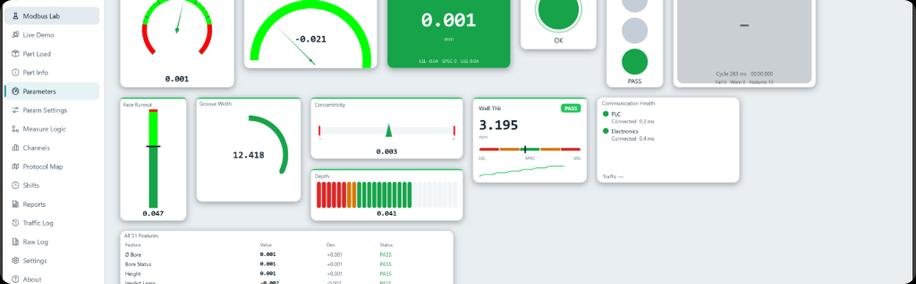
The .NET operator console shows live parameters with verdict lamps (bore, journal and height, passage and face run-out, groove width, concentricity, wall thickness and depth), a mastering view and bore trends, with machine-specific parameter set-up, configuration and reporting.

The operator console of the inspection system, parameters view, with gauges and pass or fail lamps

Outcome · deployed in India

One engineering partner for the PLC hardware, control logic and operator software. More screens on the Customized PLC page.

Controller
Customized Nuvologic PLC
Firmware
Control logic for the machine sequence
Software
.NET operator dashboards
Views
Parameters, mastering, trends, reports

Gauging

  • Bore, journal, height
  • Run-out, concentricity
  • Wall thickness, depth

Customized PLC

  • Control firmwaremachine sequence · verdicts

Operator console

  • .NET dashboards
  • Mastering · trends

Records

  • Parameter set-up
  • Reports
System outline, drawn from the project description.

Programme experience

Also engineered by the same team

Programmes delivered for OEMs in India, the USA, Mexico and Singapore, end to end by one cross-functional team.

Automotive

Lighting electronics

  • DRL, headlamp and indicator electronics: LED drivers, thermally managed constant-current stages and PWM-controlled indicator modules, with multi-channel sequencing and diagnostics
  • Automotive MCUs, high-side switches and diagnostics with open-load and short-to-battery detection
  • CAN, LIN and Automotive Ethernet integration, with OEM-supplied DBC configuration
  • Schematic review, signal-integrity checks, DFM hand-off and pilot builds with certified contract manufacturers

Lighting OEMs

Connected lighting platforms

  • Commercial: high-bay and panel drivers with thermal fold-back, DALI and 0–10 V control nodes, energy and occupancy telemetry to building-management consoles
  • Residential: Wi-Fi and BLE bulb drivers, scene controller firmware with secure OTA, and mobile-app onboarding with cloud identity

Your project

Working on something similar?

Choose the route that matches your requirement. Each opens the enquiry form with the topic already selected.